
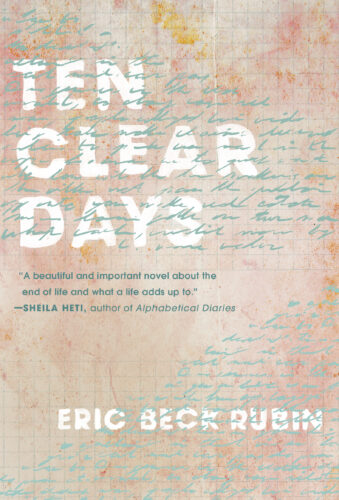
Ten Clear Days
When Eric Beck Rubin’s grandmother, a Holocaust survivor, requests medical assistance in dying, it divides her family. Over ten increasingly tense days, we come to know her story and its final outcome.
On a Tuesday night in August 2018, eighty-three-year-old Mary Beck is rushed by ambulance to the hospital. She wakes up to the news that her surgery was a success and her recovery is underway–but she doesn’t want to hear it. She had been preparing for her end. And with newly enacted legislation, she can demand it.
Before a decision can be made on whether to grant her request, a member of the non-medical hospital staff, “Au.” is brought in to record the unfolding events. But what begins as an arm’s-length report during ten mandated days that Mary awaits her fate, soon turns into a sweeping examination of a life.
From her upbringing in pre-war Hungary and survival of the war, to the start of her new life in North America, Mary, along with her family and friends, tells the story of this complicated, forceful, fiercely loved person at every stage of her extraordinary life. A life she now fights to end on her own terms.
- "In Ten Clear Days, Eric Beck Rubin beautifully explores the way the past and the present sit together. Here, the body is an archive and a memorial, the caretaker an investigator. What a carefully constructed and gorgeous, urgent novel." --Jennifer Gilmore, author of Mothers and If Only
- "This is a beautiful and important book about the end of life and what a life adds up to. It is written in a precise and delicate way, which allows us readers to witness even more clearly and deliberately those hazy and confused last days of a loved one's life. It is also a very sensitive look at assisted death and the feelings and rights of the person who wants to die, weighed up against the family." --Sheila Heti, author of Alphabetical Diaries
- "Scrupulously observed and emotionally crushing, Ten Clear Days tells the harrowing story of one family's experience with medically assisted death. Alternating between the claustrophobic world of Mary Beck's hospital room and her childhood in Hungary leading up to the Holocaust, the novel asks profound questions about what it means to let go of someone we love. Beck Rubin wields language like a scalpel, precise and unflinching. You've never read anything quite like this before." --Alison Pick, author of Far to Go